
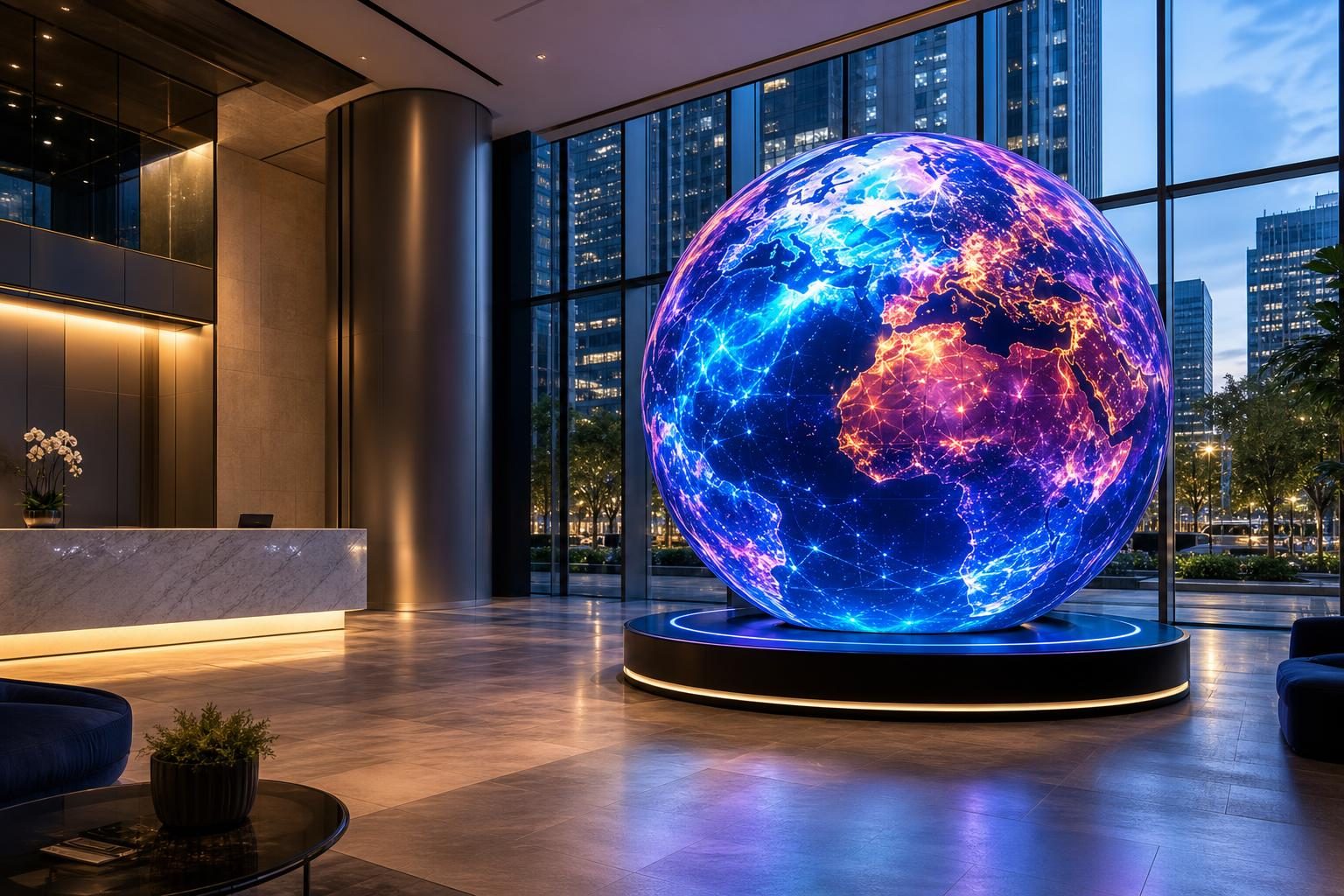
Indoor Digital Spheres in Glendale, Arizona
Indoor digital spheres in Glendale, Arizona bring spherical video and immersive visuals into sports-adjacent hospitality, retail and event venues. LED Display Warehouse helps teams compare sphere diameters, pixel pitch, controller requirements and installation approaches for each venue.

Why Choose an Indoor Digital Sphere?
An indoor LED sphere is a three-dimensional video display that can be viewed from multiple directions. Unlike a flat video wall, it presents a sculptural form that naturally draws attention in an atrium, museum, showroom or event setting. The most successful projects match the form factor to the message and the audience. Before choosing a model, identify the intended viewing distance, available space, mounting conditions, content requirements and operating schedule. For Glendale, the venue’s circulation paths and visitor expectations should influence the size and placement. A suspended sphere can create an overhead landmark, while a floor-mounted configuration can work as a closer-viewed feature when safety clearances are appropriate.
Sphere Sizes, Pixel Pitch and Resolution
Sphere diameter and LED pixel pitch are related but separate design decisions. Diameter affects the physical presence and how much space the display occupies. Pixel pitch influences how closely the audience can view the surface before individual pixels become apparent. The exact available pitches and resolutions vary by model. Request a specification for the actual configuration rather than assuming that a pitch available on a flat wall is available on every sphere size. Total pixel count, mapping format, content type and brightness settings also affect the final appearance. When visitors stand nearby, fine detail and smooth motion deserve particular attention. For long-distance viewing, the visual impact of the sphere and the clarity of large imagery may matter more than tiny text. The design team should test representative content against the proposed pixel resolution.
Applications in Glendale
For retail activations and event-adjacent experiences, a spherical display can serve as a central visual element for storytelling, branded motion graphics, planetary imagery and abstract digital art. Museums and educational spaces can present Earth, ocean and climate visualizations when properly mapped content is available. Retailers and visitor destinations may prioritize visually engaging animations that can be understood quickly from different angles. Corporate spaces may use the sphere for an identity piece or a scheduled media program. The sphere is not automatically the right choice for detailed presentations or extensive text. A conventional LED wall or nearby flat monitor may complement the sphere by displaying information that benefits from a rectangular screen. Avoid claiming that a particular institution already uses the technology unless an actual installation has been documented.
Planning the Venue and Viewing Experience
Start with the dimensions of the room, ceiling height, expected audience positions and access for delivery. Identify whether people will walk around the sphere, view it from an upper level or approach it from a single direction. The position of the display should support safe circulation and clear sightlines without blocking exits, signage or accessible routes. Consider how ambient light changes during operating hours. Brightness should be selected for comfortable indoor viewing rather than simply maximizing the available output. Lighting reflections, surrounding finishes and nearby digital signage may influence the experience. Glendale installations may serve sports and event visitors, making schedule coordination, access windows and reliable playback especially important. Outdoor heat is not an indoor sphere specification, but receiving and storage conditions still matter. Take photos and measurements early. A floor plan, elevation drawing and approximate audience distance help the supplier recommend a suitable configuration.
Suspended and Floor-Mounted Installation
Suspended spheres require a qualified review of the building structure, approved attachment points and rigging components. The mounting design should account for the complete assembly, hardware and service requirements. Never assume that a decorative ceiling can support a display. A floor-mounted sphere needs a stable engineered base and suitable protection from unintended contact. Both approaches should provide access for maintenance and safe cable routing. Check elevator dimensions, door openings, loading docks and assembly areas before shipment. Some smaller displays may be transported assembled, while larger units can require on-site assembly. Installation and rigging procedures should be confirmed for the selected product and venue. Include the venue’s safety and facilities teams before finalizing the schedule.
Power, Thermal Management and Maintenance
Electrical requirements depend on the model, size, pixel pitch and operating brightness. Request the manufacturer’s typical and peak power specifications for the exact sphere. Coordinate dedicated circuits, distribution, cable paths and any required electrical permits with the venue’s qualified contractors. LED systems also produce heat. Permanent installations should allow adequate ventilation and access for inspection or component replacement. Discuss spare modules or components, warranty coverage and the responsibilities of the local service team. A maintenance plan should identify how operators will shut down the display, reach the controller and report faults. The project is not complete when the display first turns on; it should remain practical to operate over its intended service life.

Sphere Player, Video Mapping and Playback
Spherical LED displays need content prepared for their particular pixel geometry. Standard rectangular videos may not wrap onto the surface without distortion. A compatible sphere player or processing system can support prepared content, playlists and scheduled playback, depending on the supplied configuration. Confirm supported formats, resolution and operator controls before purchasing. Live HDMI feeds, interactive sensors, networked data and real-time visualizations require separate technical evaluation; they should never be assumed to be included. Ask the creative team to produce a test sequence that checks orientation, seams, motion, color and legibility. When a sphere is used in a public venue, define who will update media, how changes will be approved and how playback problems will be resolved. These operational decisions are as important as the initial visual design.
Content Strategy and Creative Direction
Content should be conceived for an object that viewers see from several directions. Strong sphere media often uses recognizable global forms, atmospheric movement, panoramic patterns or imagery that remains meaningful as visitors circulate. Text-heavy slides, small labels and conventional advertisements may not translate well to the curved surface. Consider pairing the display with audio, lighting or surrounding flat screens where appropriate. Establish a content calendar before installation and clarify ownership of source assets. If scientific or geographic datasets are used, verify licensing and whether updates are required. Plan accessibility through complementary captions, descriptions or nearby displays rather than relying solely on a spherical animation. A commissioning review should include the people who will operate the display after the installation team leaves.
Shipping and Project Timeline
Build a schedule that includes engineering review, product selection, manufacturing, shipping, receiving, assembly, commissioning and content rehearsal. Freight timelines depend on origin, packaging, destination and the delivery service selected. For event installations, confirm the load-in window, union or venue labor requirements where applicable, equipment storage and the strike plan. Glendale installations may serve sports and event visitors, making schedule coordination, access windows and reliable playback especially important. Outdoor heat is not an indoor sphere specification, but receiving and storage conditions still matter. Request packing dimensions and weights early so the facility can confirm the receiving path. If the project has a fixed opening date, allow contingency time for inspection and media adjustments. Document who accepts the shipment, who supervises rigging and who provides final sign-off. Clear ownership of these steps reduces last-minute surprises.
Comparing Indoor Spheres with Other LED Formats
A sphere offers multi-angle visibility and a distinctive dimensional presentation. Flat direct-view LED video walls provide familiar rectangular canvases for live video, presentations and readable text. Curved LED walls, transparent LED and specialty structures can create other effects. The right format depends on the intended message, budget, room geometry and technical requirements. Compare total installed cost, not just hardware price. Include rigging, power, content production, freight, installation and long-term service. In some venues, combining a sphere with a flat screen is the best approach: the sphere attracts attention and the conventional display provides detailed information. Ask for application-specific guidance instead of choosing solely from a product photograph.
Local Project Discovery and Specification Checklist
For a project in Glendale, prepare the venue address, target diameter, desired installation date, ceiling height, nearest expected viewing distance and preferred mounting approach. Include photos, drawings and any known structural limitations. Describe the creative concept and whether playback will use prepared media or live sources. Specify the expected daily operating hours and the staff who will manage content. A complete request should also identify the delivery window, installation labor arrangements and any venue-specific approvals. This information helps LED Display Warehouse discuss suitable sphere models and identify technical questions before a quote is finalized. Product availability and exact configurations should be confirmed directly, because specifications can vary across models.
Frequently Asked Questions
Can an indoor sphere be suspended? Selected systems can be suspended when the structural and rigging design is approved for the venue. What pixel pitch is best? That depends on viewing distance, sphere size and content. Can it display Earth imagery? Yes, with properly mapped media. Does a sphere player automatically accept live video? No; confirm live-input capability and processing separately. Can the display run every day? The intended duty cycle and maintenance needs must be verified for the chosen system. How should an event team plan delivery? Confirm freight, packaging, assembly and venue load-in requirements before committing to an opening date.
Explore Technical Resources
Review AVIXA for professional AV resources and NOAA for scientific and Earth imagery background. See LED display products for related solutions. These references do not establish partnerships or project endorsements.
Indoor Sphere Selection Guide
Close Viewing
Fine pitch and comfortable brightness.
Large Atrium
Scale, sightlines and structural review.
Event Use
Freight, assembly and venue coordination.
Indoor LED Sphere Comparison
| Factor | Evaluate | Goal |
|---|---|---|
| Pitch | Viewing distance | Image clarity |
| Diameter | Room size | Visual impact |
| Rigging | Structural approval | Safe support |
| Playback | Mapped content | Compatible player |
Indoor Installation Inspiration

Illustrative concept; not a documented local installation.
Science
Earth and planetary imagery.
Retail
Branded visual experiences.
Events
Multi-angle centerpiece.
Content Workflow
01 · Create
Prepare spherical media.
02 · Map
Check geometry and seams.
03 · Play
Schedule compatible content.
04 · Maintain
Manage updates and service.
Request an Indoor Digital Sphere Quote for Glendale
Share your venue drawings, viewing distance, mounting requirements and timeline with LED Display Warehouse for a configuration-specific discussion.