
Indoor Digital Sphere in Oakland
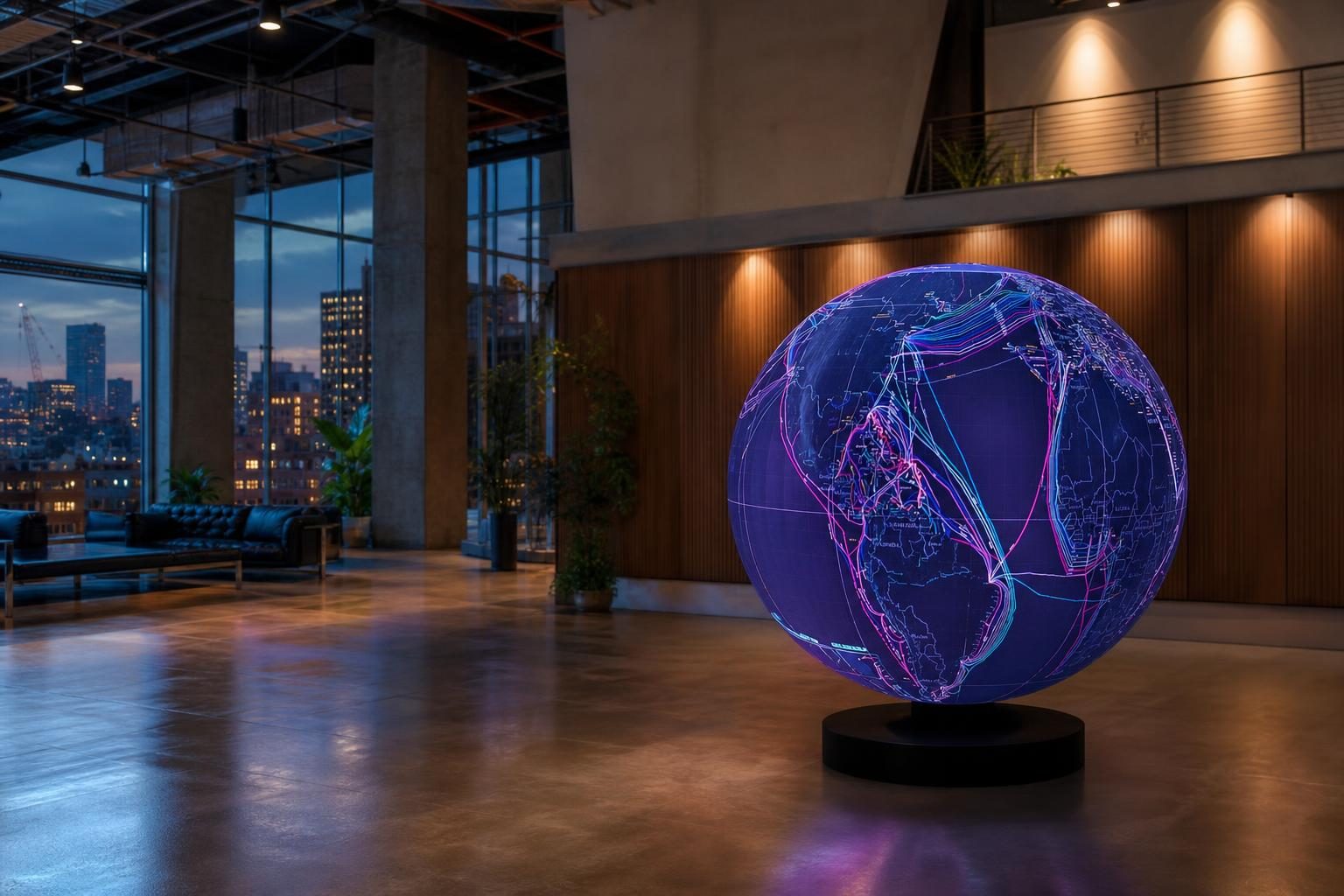
Bring captivating visual communication to life with an indoor digital sphere in Oakland, California. These high-impact LED displays create immersive experiences, presenting digital content dynamically in 360 degrees. Whether intended for events, brand environments, public spaces, or educational exhibits, an indoor digital sphere offers a fresh way to engage guests. The configuration—size, pixel pitch, brightness, and mounting—must be tailored to your venue, audience, and content objectives. LEDDisplayWarehouse.com provides guidance in selecting and specifying an indoor digital sphere suited for your project’s goals.
Why Consider an Indoor Digital Sphere in California?
Indoor digital spheres are designed to command attention and transform interior spaces throughout California. In bustling cities like Oakland, they can serve as interactive focal points in museums, lobbies, convention centers, and entertainment venues. Spherical displays allow for content that is visible from almost any angle, making them ideal for dynamic presentations, real-time data, and immersive storytelling. The unique form factor lends itself to innovation and creativity—making a striking impact at corporate headquarters, science centers, or university entrances. Uses range from artistic installations to branding and educational content, giving venues in California a modern edge in visual engagement. Depending on your vision, an indoor digital sphere may serve as the centerpiece for new development, a technology refresh, or a special event environment.
Applications for Indoor LED Spheres in Oakland and Beyond
Convention and Event Spaces
In Oakland’s expansive conference centers and trade show halls, indoor LED spheres can anchor exhibit entrances or main stages. Their ability to display branded loops, event schedules, sponsor visuals, or interactive content attracts visitors from across the floor. Event planners may use motion graphics or announcement reels to guide attendees or highlight programming.
Museums and Educational Venues
Science centers and history museums across California can leverage digital spheres to visualize scientific phenomena, world maps, or historical timelines. With content ranging from rotating globes to animated simulations, educators can craft memorable interactive experiences for students and visitors alike.
Corporate and Hospitality Environments
Corporate lobbies and hotel atriums become more inviting with a central digital sphere display. These installations can feature brand stories, welcome messages, stylized California landscapes, or data-driven displays—enhancing first impressions and reinforcing brand identity for guests and visitors.
Retail and Brand Activations
Flagship retailers and major shopping centers in Oakland may incorporate indoor LED spheres as attention-getters, highlighting product launches, thematic campaigns, or artistic digital art. The sphere’s unique posture draws shoppers and helps brands distinguish their space.
Universities and Campus Engagement
On university campuses, digital spheres in student centers or libraries foster engagement by presenting school news, event reminders, academic highlights, or creative student projects in an interactive, visually stunning format.
Product and Configuration Considerations
- Sphere Size: Available diameters vary and should be chosen to best fit the space and expected audience size. Confirm options with the sales team.
- Pixel Pitch: Determines the level of image detail. Tighter pixel pitch displays are ideal for closer viewing.
- Viewing Distance: Select a resolution that matches typical audience proximity for sharp, engaging visuals.
- Mounting Solutions: Choose from floor stands, suspension, or architectural integration based on ceiling height, structural allowances, and design intent.
- Power and Networking: Plan for sufficient electrical access and network connectivity for control and content updates.
- Content Formats: Ensure that your video and graphic content can be mapped onto a spherical display and that workflows meet your team’s needs.
- Maintenance Access: Spheres require periodic maintenance. Consider placement and allow access for service personnel.
- Operational Workflow: Identify who will manage content updates, scheduling, and system monitoring.
- Environmental Requirements: Indoor-only usage—confirm temperature, humidity, and ventilation meets product requirements.
Buying Criteria and Selection Guidance
Choosing the ideal indoor digital sphere for your Oakland project calls for a careful assessment of several interdependent factors. Here’s a breakdown to help guide informed decisions:
- Spatial Architecture: Assess the architectural context—measuring the openness of the intended space, ceiling heights, and pathways for audience flow. A sphere should serve as a visual anchor, neither overwhelming the venue nor appearing lost in a large hall.
- Intended Functionality: Are you aiming for continuous branding, scientific visualization, interactive experiences, or event-centric usage? Your primary application will drive key choices, from size to control systems.
- Lighting Conditions: Evaluate the ambient lighting in the venue. Spheres installed under bright atrium skylights may require higher brightness levels versus those in a dimly lit gallery.
- Audience Demographics and Behavior: Will your primary traffic be children, professionals, or mixed public audiences? For high-traffic event centers, robust construction and easy content update mechanisms are critical.
- Budget Constraints: Understand not only initial purchase price but also lifecycle costs, including installation complexity, energy usage, routine servicing, and content management.
- Integration Requirements: Consider whether the sphere needs to synchronize with ambient music systems, lighting, or third-party content feeds, such as real-time social media or environmental data.
- Accessibility and Compliance: For public venues, confirm ADA accessibility and adherence to California codes—ensure enough space for circulation and maintenance.
Installation and Planning Considerations in Oakland
Proper planning is vital for a seamless installation process and optimal long-term performance. Consider these steps specifically for Oakland-based projects:
- Permitting and Approvals: Research any necessary city or venue permits for installation, especially in heritage, civic, or university settings.
- Site Survey: Conduct a thorough survey to identify ideal sphere placement within high-foot-traffic zones, view corridors, and audience gathering spaces.
- Logistics and Access: Confirm delivery routes—evaluate loading docks, elevator dimensions, and clearances for maneuvering the sphere and equipment through the building.
- Structural Evaluation: Collaborate with facilities teams or structural engineers to confirm the location can support the sphere’s weight and mounting solution.
- Pre-Installation Readiness: Ensure the site has completed all preparatory work, including electrical rough-in, network cabling, and environmental controls.
- Testing and Commissioning: Allocate time for trial operation, content testing, and user training prior to grand opening or scheduled public access.
Environmental and Lighting Considerations
To achieve optimal viewing quality and preserve the lifespan of your digital sphere, plan for:
- Consistent Ambient Lighting: Install adjustable architectural lighting to reduce glare and maintain content vibrancy across changing daylight conditions.
- Controlled Climate: Maintain stable indoor temperatures and humidity levels, particularly in Oakland where weather shifts can fluctuate indoor environments.
- Air Circulation: Prevent overheating by ensuring adequate ventilation around the sphere’s housing and electronics.
- Audience Positioning: Avoid positioning the sphere where direct sunlight or bright artificial lights routinely strike the display surface.
Material and Performance Considerations
For institutions and businesses in California seeking a reliable indoor digital sphere, pay attention to:
- Surface Durability: Durable housing and sphere shell construction are important for public or high-traffic venues.
- Modular Design: Modularized panels (as supported by the chosen product) can facilitate both transport and in-field servicing.
- Color Fidelity: High-quality modules ensure accurate reproduction of both vibrant and subtle colors across the full display surface.
- Smoothness of Curvature: Spheres with seamless transitions between display segments result in more immersive, distraction-free content delivery.
- Refresh Rate: For interactive or video-heavy applications, a higher refresh rate ensures smooth visuals under both in-person viewing and camera capture.
Maintenance and Operational Practices
Proactive maintenance ensures continued performance and protects your investment:
- Regular Cleaning: Use only recommended cleaning materials for dust removal and surface care to prevent artifacts or pixel damage.
- Scheduled Inspections: Arrange periodic system diagnostics, including software updates and hardware checks.
- Staff Training: Designate at least one trained operator for daily checks, content scheduling, and basic troubleshooting.
- Service Access: Select a mounting approach that allows safe technician access for component replacement or repairs.
- Documentation: Maintain an accessible record of system settings, warranties, and service visits.
Use Cases: Transforming Oakland Spaces with Indoor Digital Spheres
- Public Art Installations: Museums and civic centers in Oakland can use digital spheres as modern art canvases, rotating seasonal or commissioned digital artwork that reflects the Bay Area’s vibrant creative scene.
- Corporate Welcome Zones: Technology firms and business campuses can utilize spheres for real-time data visualization, enhancing decision-making spaces and making bold statements at entry points.
- Cultural Exhibitions: Spheres showing animated world maps, indigenous history, or biodiversity simulations elevate the interpretive power of museum or science displays.
- Retail Destination Areas: In shopping malls, interactive gamified experiences presented on a sphere can attract families, gamifying loyalty programs or product discovery.
- Hospitality Digital Concierge: Luxury hotels and convention centers may integrate spheres as dynamic concierge kiosks, cycling guest greetings, event schedules, and ambient digital art to set a sophisticated tone.
Common Mistakes When Planning an Indoor Digital Sphere Project
- Underestimating the space needed for installation and audience circulation.
- Choosing inappropriate pixel pitch for expected viewing distance.
- Not accounting for ongoing content creation and management needs.
- Failing to coordinate early with venue management or facilities teams.
- Assuming off-the-shelf content will transfer seamlessly to spherical formats.
- Overlooking maintenance access and future servicing requirements.
- Neglecting to plan handoff procedures for staff turnover or changes in operational personnel.
- Inadequate planning for software or firmware updates that can impact reliability.
Comparison Table: Indoor Digital Sphere vs. Other Displays
| Feature | Indoor Digital Sphere | Flat Indoor Display | Projection System |
|---|---|---|---|
| Viewing Angle | 360-degree, multi-directional visibility | Limited; primarily head-on | Depends on projector placement |
| Audience Engagement | High; surrounds and draws movement | Moderate; fixed along wall | Flexible; subject to shadowing and surface limitations |
| Spatial Presence | Physical, sculptural centerpiece | Wall-bound and space efficient | Variable; reliant on open wall space |
| Content Capability | Spherical mapping, animated wraps, immersive art | Conventional video, graphics | Video, slides, basic mapping for 3D if supported |
| Maintenance | Requires physical access; periodic | Wall accessible; generally routine | Lamp changes, periodic calibration |
| Installation Complexity | Moderate to high due to structural and access needs | Low to moderate | Low; screen and projector mounting needed |
Content Creation and Mapping Guidance
Effective use of an indoor digital sphere hinges on well-designed content, uniquely suited to the curved surface. Consider:
- Custom Animation Development: Collaboration with digital artists or agencies may be needed to adapt branding and storytelling to spherical geometry.
- Real-Time Data Integration: Leverage data feeds for sports, news, scientific data, or social media for constantly refreshing visual engagement.
- 360° Interactive Experiences: Plan for touchless gestures or motion sensors if interactive elements are intended (with support for these features as available).
- Scheduled Programming: Set up automated content loops or daily schedule rotations for exhibitions and event-driven messaging.
- Localization: For multi-lingual California audiences, incorporate language options or context-aware content to maximize reach.
Future Trends: Indoor Digital Spheres
The evolution of indoor digital spheres in California points toward increased integration with interactive and immersive technology. As venues invest more in experiential environments, expect future spheres to offer higher resolution, enhanced interactivity (where supported), and advanced content mapping capabilities. Trends may include integration with event management systems, augmented reality experiences, or modular designs for flexible layouts. Always validate the availability and suitability of these features with the supplier for your project and timeline. Additionally, improvements in eco-friendly materials and energy efficiency are likely to shape future installations—aligning with California’s sustainability values. Artificial intelligence may streamline content scheduling and even personalize audience experiences in public spaces while cloud-based content management platforms could further simplify remote programming and analytics.
Frequently Asked Questions
- Is the indoor digital sphere designed for indoor use only?
- Yes, these spheres are engineered specifically for interior environments. For outdoor projects, inquire about specialized solutions.
- What information do I need to start planning a digital sphere in Oakland?
- Prepare your venue details (dimensions, ceiling height, access), intended use case, estimated audience size, preferred timeline, and any known content or control requirements. The more details you share, the better guidance the team can provide.
- How does pixel pitch affect my project selection?
- Pixel pitch describes the spacing between LED pixels and directly affects image detail. Closer (smaller) pixel pitches deliver sharper visuals, important for installations with close audience proximity. Confirm the best option during your consultation.
- What content formats can be used on a digital sphere?
- Supported content formats may include video, animation, and still images mapped for a spherical display. Content should be prepped to match the physical and technical properties of your chosen sphere.
- Does LEDDisplayWarehouse.com provide installation services in California?
- Consult with the sales team to confirm available installation coordination and support for California projects. Detailed delivery and service options depend on the specific project requirements and venue policies.
- How do I request a quote or project review?
- Use the form or contact route provided on LEDDisplayWarehouse.com to describe your venue, application, location, display needs, and desired project timeline. A display specialist will help evaluate your requirements and discuss next steps.
- How often does an indoor digital sphere require maintenance?
- Routine maintenance schedules depend on usage intensity, ambient conditions, and content cycles. Plan for regular system checks and occasional surface cleaning. Your supplier can recommend an optimal frequency for servicing and provide support resources.
- Are digital spheres suitable for interactive exhibits?
- Some models support interactive features, either through motion sensing, touchless control, or external input devices. Define your audience experience needs in advance to select a compatible solution with required interactivity.
Call to Action: Discover the Impact of an Indoor Digital Sphere
If you’re ready to explore an indoor digital sphere for your Oakland, California venue or organization, request expert guidance by connecting with a display specialist at LEDDisplayWarehouse.com. Here’s how to get started:
- Indicate your state and city
- Describe your venue or organization type (museum, event space, retail, corporate, etc.)
- Specify the intended application: branding, exhibits, events, education, etc.
- Mention any preferences regarding size, interactivity, or installation timeline
- Detail your primary audience and viewing distances
- Prepare venue/site drawings if available (optional for deeper consultation)
- Include any technical, delivery, or content management questions
- Supply your contact details (name, organization, phone, email)
Request a Project Quote today to discover how an indoor digital sphere can transform your Oakland space. Recommendations will always be matched to your unique goals, technical needs, and audience requirements. Final specifications, delivery, installation, and pricing details are provided through direct consultation for transparency and project success.
More Indoor Digital Sphere in California
- Bakersfield, California
- Fresno
- Long Beach
- Riverside: Immersive Visual Solutions
- Sacramento, California
- San Diego, California
All California cities · Indoor Digital Sphere · All locations