
Indoor Digital Sphere in Idaho
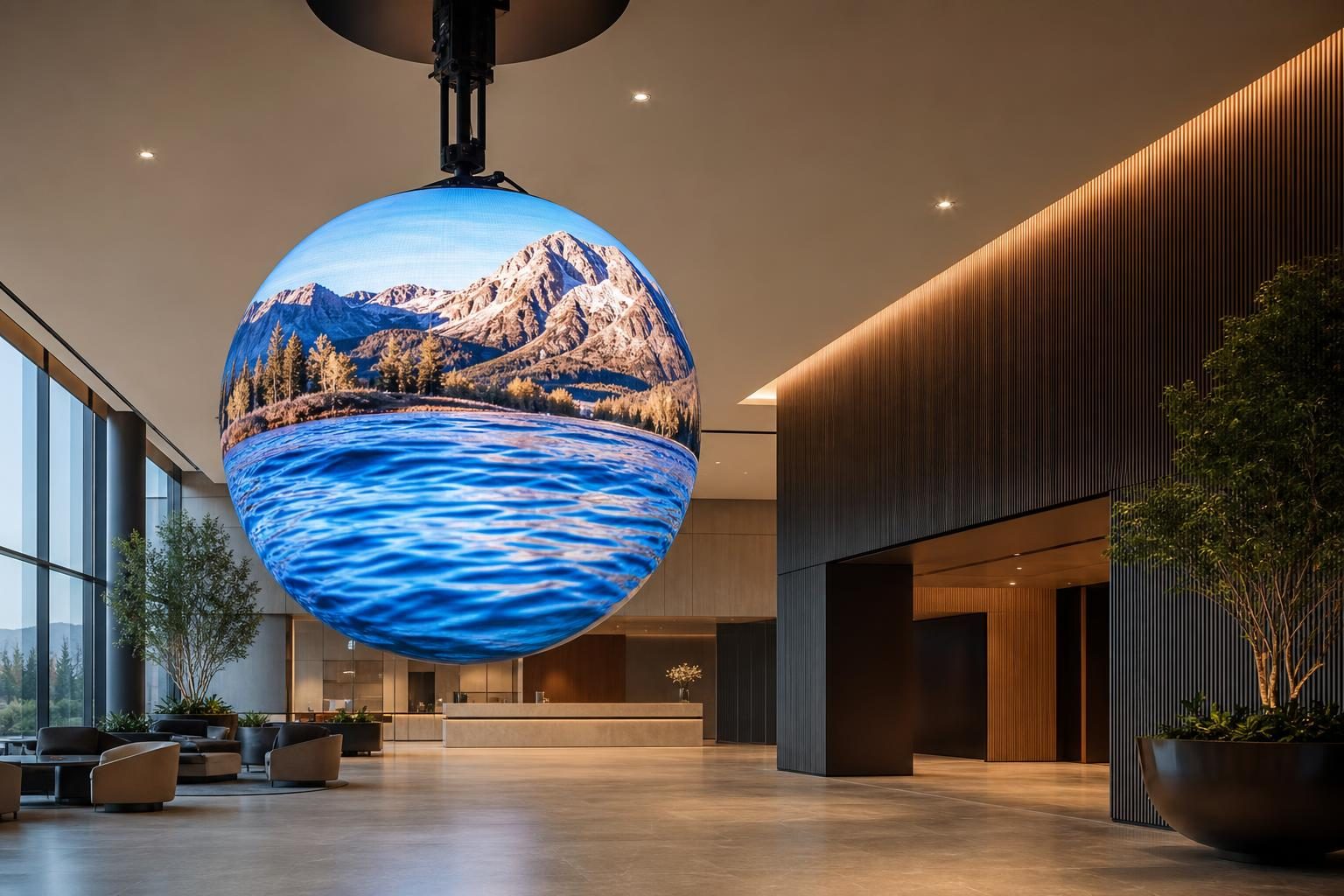
- Event and Convention Centers: Act as attention-grabbing focal points for conferences, trade shows, and exhibitions. Spheres run sponsor videos, welcome animations, or event schedules visible from anywhere in an expo hall.
- Museum and Science Centers: Elevate learning with interactive Earth models, visualizations of astronomical phenomena, or historical timelines presented in a captivating, three-dimensional format.
- Corporate Headquarters and Offices: Reinforce brand values and present corporate storytelling through immersive motion graphics, real-time dashboards, or milestone presentations in lobbies and meeting areas.
- Universities and Educational Spaces: Display student achievements, campus news, or interactive class content in student centers and common areas to boost engagement and foster community.
- Hotels, Casinos, and Resort Venues: Distinguish property interiors with spheres that run artful visuals, personalized welcome messages, or live entertainment schedules, enhancing visitor experience and property value.
- Retail Environments: Promote special offers, product launches, or seasonal campaigns, encouraging foot traffic and increasing time spent in-store.
- Public Sector and Government Spaces: Share civic information, public art, or dynamic data in libraries, visitor centers, and transportation hubs, creating informative and attractive environments for Idaho communities.
Guidance for Selecting an Indoor Digital Sphere in Idaho
- Visual Performance: Look for high-brightness emittance with suitable color rendering for interior lighting conditions. Even at low ambient light, displays should remain sharp and consistent.
- Surface Quality: Seamless integration of the digital surface is essential to maintaining the spherical illusion from every angle, free of distracting gaps or misalignments.
- Durability: Materials should be easy to clean, scratch resistant, and resistant to temperature or humidity fluctuations commonly found in Idaho’s climate-controlled interiors.
- Software Flexibility: Sphere management systems should allow easy scheduling, live updates, and smooth transitions across the entire display area, including support for specialized visual effects.
- Energy Efficiency: Consider solutions designed for minimal power consumption relative to display size, meeting sustainability goals and lowering operational costs in the long run.
Maintenance and Long-Term Operation
For custom engineering and integration, visit Screen Solutions International Screen Solutions International.
- Cleaning: Establish regular cleaning protocols suited to the sphere’s finish and usage environment, avoiding abrasives or harsh chemicals.
- Health Monitoring: Monitor system status, display health, and connectivity through built-in diagnostics or remote support, where available.
- Software Updates: Keep all media players, controllers, and associated content software up to date for optimal reliability and security.
- Content Refresh: Schedule regular content updates to maintain engagement and relevance for your venue’s changing audience profiles.
Buying Criteria and Comparison Guidance
For exterior venues or projects that need weather-rated spherical LED, compare our outdoor digital sphere solutions. Outdoor Digital Sphere.
For applications better suited to a traditional large-format surface, explore our indoor LED video wall options. Indoor LED Video Wall.
For statewide business and economic-development resources in Idaho, consult the Idaho Department of Commerce Idaho Department of Commerce.
Planning and Site Assessment
Successful procurement and long-term use of an Indoor Digital Sphere begin with a structured planning and site-assessment process. Early-stage discovery should involve the project stakeholders, including facility managers, architects, structural engineers, AV integrators, IT/network staff, content managers, and operations teams. The goals of the site assessment are to validate sightlines, structural support, power and cooling availability, cable routing paths, and service access for routine maintenance.
- Stakeholder alignment: Identify primary objectives for the sphere (branding, wayfinding, education, data visualization, revenue generation through sponsorships) and record functional and aesthetic requirements.
- Sightline mapping: Document visitor flow patterns, typical viewing distances, and angles from surrounding spaces to determine appropriate placement and scale relative to the venue.
- Structural survey: Coordinate with a licensed structural engineer to confirm that proposed mounting points, floors, or support structures meet load and safety requirements. Include provisions for temporary load during installation.
- Access and egress: Confirm clear access for equipment delivery, staging, and installation crews, and plan for safe methods to lift and position the sphere in place without disrupting concurrent venue operations.
- Power and HVAC considerations: Map existing electrical panels, back-up power sources, and cooling capacity. Plan for dedicated circuits, redundant feeds if required, and the impact of continuous operation on the facility’s HVAC systems.
- Network and IT readiness: Verify network reach, bandwidth, and security posture. Discuss whether content will be pushed locally, streamed, or controlled via a cloud-based management platform, and plan VLANs, firewall rules, and QoS with IT.
AV, Control, and Network Integration
Digital spheres are complex audiovisual systems. Clear design for control, synchronization, and content distribution ensures the sphere performs reliably within a broader AV ecosystem.
- Media players and controllers: Determine the number and type of media players, video processors, and redundancy required. Ensure these components are accessible for servicing and secure from unauthorized access.
- Time synchronization: If the sphere must align with other displays or live events, design a synchronization strategy using network time protocols or dedicated sync hardware.
- Streaming vs local playback: Evaluate the benefits and tradeoffs of local content playback versus live streaming based on available bandwidth, latency tolerance, and reliability requirements.
- Monitoring and remote access: Plan for remote diagnostics, logging, and secure remote access for updates and troubleshooting, while following the venue’s cybersecurity policies.
Content Strategy and Production Workflow
Content is the raison d’être for a sphere. A deliberate content strategy maximizes the investment by ensuring material is appropriate to the form factor and audience.
- Content types and lifecycle: Define categories such as branded animations, informational graphics, dynamic data-driven visualizations, sponsorship spots, and live feeds. Specify update frequency and approval workflows for each category.
- Aspect mapping and authoring: Spherical displays do not display flat rectangular media the same way as conventional screens. Create authoring guidelines and templates so designers produce content that maps correctly to a sphere’s surface without distortion or unintended cropping.
- Production pipeline: Set up a production pipeline with clear roles—content producers, editors, quality assurance, and scheduling. Use version control and archiving to manage assets over time.
- Testing and previewing: Implement a preview environment that allows stakeholders to validate content on a spherical simulation or temporary test rig before committing to a live playlist.
- Sponsorship and monetization: If the sphere will host third-party sponsorship, define ad formats, durations, scheduling rules, and reporting metrics ahead of procurement so the sales and legal teams can create consistent packages.
Procurement, Vendor Selection, and RFP Tips
When inviting bids, produce an RFP or RFQ that communicates technical, operational, and commercial needs clearly to vendors so responses can be compared objectively.
- Define required deliverables: Include desired scope such as design, fabrication, mounting hardware, controllers, software licensing, cabling, and commissioning services.
- Request documentation: Ask for references, technical data sheets, sample content mapping, installation plans, and maintenance options so you can evaluate proposals on comparable criteria.
- Evaluation criteria: Score proposals across visual quality, service and maintenance offerings, software flexibility, integration capability, project management approach, and total cost of ownership considerations.
- Contract terms to consider: Clarify acceptance testing, milestones, payment schedules tied to deliverables, spare parts availability, and escalation paths for service issues.
- Proof-of-concept and demonstrations: Where possible, require vendors to demonstrate mapping tools or provide short proof-of-concept content relevant to your venue to validate their approach.
Buyer Evaluation Checklist
Use this checklist during vendor evaluation and site readiness reviews:
- Has a comprehensive site survey been completed and documented?
- Are structural and electrical capacities confirmed with stamped engineering where required?
- Have sightlines and viewing angles been validated for typical visitor positions?
- Does the vendor provide tools for content mapping and previewing for spherical geometry?
- Is the proposed control architecture consistent with your IT security policies?
- Are software licensing terms, update policies, and remote access methods transparent?
- Does the proposal include clear acceptance test criteria and a commissioning plan?
- Is a spare parts list and maintenance plan included, along with training for your staff?
- Does the total cost of ownership analysis include energy consumption, maintenance, and content production costs?
Risk Mitigation and Acceptance Testing
Include acceptance and commissioning tests to confirm the system performs to expectations before final acceptance. Typical acceptance testing addresses power draw verification, color and uniformity checks, controller failover tests, network security validation, and content scheduling validation. Define remedial steps and retesting procedures for any items that fail.
Mitigate installation risks by staging critical assemblies off-site, if feasible, and by using modular approaches to reduce time spent at height or in constrained venue spaces. Establish a single point of contact for coordination between the venue, vendors, and third-party contractors for a smooth execution.
Operational Considerations and Monthly Planning
Create a monthly operations calendar that coordinates content refresh cycles, firmware and software updates, and periodic cleaning. Align content refreshes with venue marketing campaigns, seasonal programming, or conference schedules to maximize relevance. Keep a rolling log of incidents and repairs to inform future procurement and maintenance budgeting.
Questions to Ask Potential Vendors
- How do you manage geometric mapping and color calibration for spherical displays?
- What are your recommended content authoring tools and output formats for spheres?
- How is redundancy handled for controllers and media playback?
- Can you provide a proposed commissioning checklist and acceptance test plan?
- What options exist for remote monitoring and secure remote support?
- How are software updates delivered, and what is your policy for critical security patches?
Summary
Indoor digital spheres are powerful visual assets that require deliberate planning across site assessment, procurement, installation coordination, content strategy, and maintenance planning. By engaging the right stakeholders early, documenting clear acceptance criteria, and ensuring integration with facility systems and IT policies, Idaho venues can deploy immersive spherical displays that meet functional goals while remaining serviceable and sustainable over time. Refer to the product page for more details on available configurations: Indoor Digital Sphere.
When installation planning depends on local environmental conditions in Idaho, consult the National Weather Service for official weather and climate information National Weather Service.
LEDDisplayWarehouse.com sells LED display products. Contact us through our contact page to ask questions or request a quote.