
Indoor LED Sphere Solutions in North Dakota
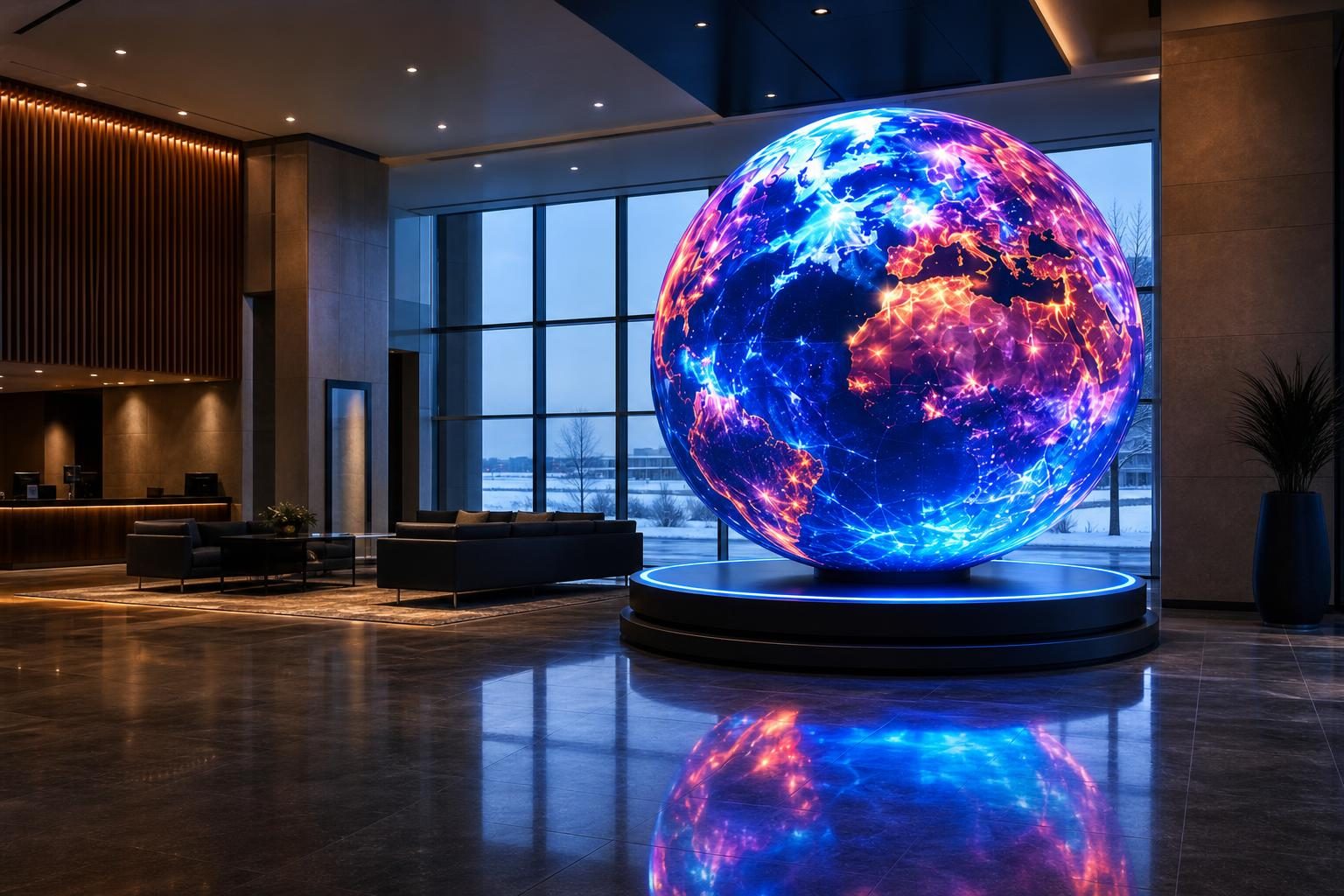
If you are searching for a revolutionary visual solution that transcends conventional display technology, the indoor digital sphere offers a unique and engaging method to transform North Dakota’s most important indoor venues. From executive lobbies to museum spaces and event centers, this spherical display technology opens avenues for immersive storytelling, interactive experiences, and dynamic branding—all within the confines of a visually captivating sphere. With the flexibility to meet educational, commercial, and creative needs alike, the indoor digital sphere represents a bold leap forward in interior digital signage and audience engagement.
Why Choose an Indoor Digital Sphere in North Dakota?
Businesses, educational institutions, cultural venues, and hospitality spaces throughout North Dakota are consistently seeking advanced and creative ways to stand out. An indoor digital sphere offers an all-angle visual experience, transforming any space into a memorable destination. Key benefits of choosing this innovative technology include:
- Central Visual Attraction: A digital sphere is inherently attention-grabbing, becoming a natural focal point in large lobbies, galleries, open-plan offices, or multi-functional atriums. Its shape stands in contrast to flat displays, encouraging guests to gather and explore from all directions.
- 360-Degree Messaging: Unlike wall-bound screens, a digital sphere can present messaging, branding content, and animated artwork in 360 degrees, ensuring continuous engagement no matter where your visitors are standing.
- Support for Interactive Experiences: Many digital spheres can be configured to enable touch or gesture interactivity, allowing visitors to control content, explore data, or play educational games, making them ideal for classrooms, science centers, or public exhibits.
- Versatility in Programming: The content displayed can be programmed to suit any occasion, whether that is rotating sponsor logos, branded animations, real-time event updates, interactive exhibits, or even real-time data feeds. Adaptability makes digital spheres especially suited for venues with regularly changing programming.
- Alignment with Modern Design Trends: As new construction and renovations favor clean lines, open spaces, and forward-thinking design, a digital sphere seamlessly integrates with modern architectural aesthetics and user expectations.
Advancing technology and creative thinking mean North Dakota’s indoor environments—from Bismarck to Grand Forks—are increasingly integrating digital spheres into their interior design and communications strategy.
Ideal Applications for Indoor Digital Spheres in North Dakota
Indoor digital spheres are remarkably versatile, making them suitable for a wide variety of uses and settings throughout North Dakota. Some of the most compelling applications include:
- Convention Centers & Trade Shows: Use digital spheres as central attractions in event spaces to present real-time event schedules, promotional sponsor loops, interactive registration assistance, or even live feeds from other parts of the venue. Their 360-degree visibility increases reach and draws in foot traffic.
- Education & Research Institutions: Universities and science centers benefit from spherical displays for immersive presentations of planetary data, molecular models, or interactive educational modules. The format is particularly impactful in STEM education exhibits, where students can engage with dynamic visuals that wrap around the sphere.
- Corporate Headquarters & Office Buildings: A digital sphere creates a vibrant welcome for visitors and clients, showcasing brand identity, keynote videos, investor highlights, and dynamic data relevant to the organization. This can reinforce messaging in executive lobbies, meeting spaces, and open-plan offices.
- Museums & Art Galleries: Curators and exhibit designers can present digital art, interactive maps, historical reconstructions, or global data visualizations, adding innovative storytelling methods to their collection display strategy.
- Public Spaces & Government Facilities: Use spheres for civic wayfinding, emergency alerts, tourism information, or community programming. Their visibility ensures messages are seen by everyone in communal spaces such as city halls, libraries, and cultural centers.
- Hospitality & Entertainment Venues: Install a digital sphere in hotel lobbies, casinos, event halls, or resort lounges to offer entertainment content, event updates, localized art displays, or immersive mood lighting effects that elevate guest experiences.
- Retail Environments: Shopping malls and large retailer flagship locations can use digital spheres to introduce product launches, feature seasonal campaigns, or run creative interactive promotions that invite customers to connect with the brand in unique ways.
Content may range from detailed 3D animations, real-time data visualizations, and environmental scenes to simple informative text, interactive experiences, or even live broadcast feeds—depending on the platform’s capabilities and the goals of each venue.
Key Considerations for Indoor Digital Sphere Selection
Choosing the right digital sphere for your North Dakota venue involves careful evaluation of technical, logistical, aesthetic, and budgetary factors. The following aspects need attention during the planning stage:
- Size & Scale: Measure the intended installation area, ceiling height, and circulation paths. Spheres come in various diameters and should complement—not overwhelm—the available space.
- Resolution & Image Clarity: Image resolution should match the expected typical viewing distance. For closer interactions, a higher-resolution sphere provides clearer visuals and a more satisfying audience experience.
- Mounting Type: Determine if the installation will be suspended from the ceiling, mounted on a pedestal, or incorporated into a custom architectural structure. Each approach has implications for structural support, safety, and accessibility.
- Environmental Factors: Assess indoor climate variables, including temperature stability, ambient lighting, airflow, and humidity. These factors may influence both display performance and long-term reliability.
- Content Management System (CMS): Evaluate whether the in-built or recommended CMS software meets your team’s needs for scheduling, updating, and controlling content. Some environments require integration with external data feeds, interactive controls, or remote management tools.
- Accessibility: Ensure walkways, viewing clearance, emergency exits, and ADA requirements are maintained with the sphere in place.
- Maintenance: Plan for convenient access to the sphere’s components for cleaning, software updates, repairs, and eventual upgrades, keeping downtime minimal.
- Budget Considerations: Factor in not just the upfront cost of the display, but also installation, programming, ongoing operational costs, training, and potential future expansion or upgrades.
Careful planning helps ensure the selected product fully aligns with your venue’s ambiance, audience, and operational needs.
Step-by-Step Guide: Planning Your Indoor Digital Sphere Project
Deploying an indoor digital sphere in any North Dakota setting should follow a thoughtful process to ensure project success from concept to operation:
- Define Your Objectives: Clearly outline the intended use cases, target audience, content types, and any key performance criteria for the sphere in your space.
- Assess Your Venue: Gather detailed information on room dimensions, ceiling height, load-bearing capabilities, ambient light, HVAC flow, existing AV equipment, and electrical/data infrastructure.
- Develop a Visual and Technical Plan: Work with design and engineering professionals to determine sphere size, placement, mounting method, sightlines, and integration within space aesthetics.
- Review Content Opportunities: Consider both initial and future content needs. Brainstorm with marketing, events, or educational teams to develop engaging, purposeful programming.
- Consult on Compliance: Ensure the design meets local North Dakota building and fire codes, ADA standards, and any internal facility regulations.
- Plan Installation Logistics: Map out delivery routes, access for large components, lift requirements, safety protocols, and project scheduling to prevent disruption of venue operations.
- Organize Training: Set up initial and ongoing training for local staff who will manage content and perform routine maintenance.
- Finalize Budget and Timeline: Secure budget approvals and establish clear project milestones, from initial coordination to installation, commissioning, staff training, and launch.
Professional planning and open communication among your facility, technical partners, and project stakeholders is essential for a smooth digital sphere rollout.
Use Cases: Inspiring Content for North Dakota Venues
The true power of an indoor digital sphere lies in its content and the creativity with which it’s used. Below are some effective content strategies and real-world examples tailored to various North Dakota settings:
- Historical & Geographical Storytelling: Museums and cultural centers can display rotating exhibits of local history, geological models of the Dakota landscape, or immersive reconstructions of historical events in a way guests have never seen before.
- Immersive Art Installations: Digital artists, university programs, and galleries can rotate vibrant, interactive art shows, spotlighting local creators or presenting global digital artwork competitions.
- Engaging Science & Technology Exhibits: Science centers, research labs, and university STEM programs can use spheres to visualize astronomical data, demonstrate molecular dynamics, or display earth sciences content with interactive features.
- Real-Time Information Feeds: Use the display for weather updates, live news headlines, conference and event schedules, or transportation notifications in airports and major public venues.
- Brand Awareness & Marketing Campaigns: Corporate lobbies can run highlight reels of recent achievements, welcome international partners, or present mission statements as visually stimulating, animated displays.
- Tourism & Local Promotions: Hospitality venues may show time-lapse landscapes of North Dakota’s scenic highlights or run campaigns supporting local businesses and attractions.
- Interactive Educational Games: Schools and children’s museums can entertain and educate students with interactive quizzes, games, or language-learning exercises displayed simultaneously to large groups.
Whatever the mission—informing, entertaining, sales, or engagement—thoughtful content that leverages the sphere’s geometry offers maximum impact with audience retention and positive memories.
Performance & Environmental Factors
The performance and long-term reliability of an indoor digital sphere in North Dakota will be affected by the site’s unique environmental conditions. It’s important to account for:
- Ambient Light Management: While modern spheres are bright, excessive overhead or side lighting can affect visibility or color fidelity. Adjusting in-room lighting to reduce glare enhances image quality.
- Temperature & Humidity Control: Equipment longevity depends on stable, non-extreme temperatures and minimal exposure to excess moisture.
- Air Quality: Excess dust or particulate matter impacts maintenance frequency and should be minimized in installation zones.
- Noise Considerations: Some digital spheres rely on internal cooling fans or low-level operational noise, which may need to be considered in noise-sensitive environments such as libraries or classrooms.
Pre-installation environmental assessments and ongoing monitoring help ensure consistent high performance and operational safety.
Maintenance and Care
To maximize your indoor digital sphere’s lifespan and minimize downtime, develop a robust maintenance plan that addresses:
- Scheduled Cleaning: Dust, fingerprints, and other contaminants should be regularly removed from the display’s surface using recommended procedures to maintain visual brilliance.
- Software Updates: Keep all device firmware and software current to maintain security, compatibility, and access to the latest features or performance improvements.
- Component Inspections: Assign trained staff to inspect mounting hardware, cabling, and power connections, particularly after events or room changes.
- Documentation & Training: Secure all technical documentation, service manuals, and user guides for reference and staff training. Regular refresher training ensures operational consistency.
Proactive care will help protect your investment and reduce unexpected downtime.
Indoor Digital Sphere vs. Traditional Displays: A Comparison
| Feature | Indoor Digital Sphere | Traditional Flat Display |
|---|---|---|
| Viewing Angles | 360° all-around visibility | Front-facing, limited angles |
| Visual Impact | Sculptural, standout centerpiece | Commonplace, blends into walls |
| Interactivity Options | Potential for gesture/touch interfaces | Standard touch screens or passive |
| Content Format | Curved, wraparound, spherical | 2D, rectangular grid |
| Mounting Flexibility | Can be suspended, pedestal, or built-in | Wall, kiosk, ceiling mount |
| Programming Complexity | Requires specialized content preparation | Simple media file playback |
| Cost | Premium investment with greater impact | Broad price range, often lower |
| Ideal Use Case | Iconic, large-scale visual statements | Menu boards, signage, standard wayfinding |
| Installation Timeline | Requires advanced planning | Quicker, less site disruption |
Common Mistakes in Digital Sphere Planning
- Overlooking Venue Constraints: Underestimating the importance of adequate space, improper ceiling height, or load bearing calculations can limit installation options or necessitate costly retrofits.
- Content Design Misalignment: Creating or using non-spherical content formats results in distortion and poor visibility. Content should be mapped specifically for curvature and pixel coverage.
- Neglecting Maintenance Access: Failing to provide clearance or front-access panels can hinder regular servicing or emergency repairs, resulting in longer downtimes.
- Ignoring Power and Network Planning: Not coordinating with facilities management to ensure sufficient electrical, network, and cooling infrastructure is a common oversight.
- Lack of Operational Training: Not investing in training for staff responsible for content updates or first-line troubleshooting can cause avoidable operational issues.
Emerging and Future Trends
The digital display landscape continues to evolve, with indoor digital spheres at the forefront of this innovation. Some trends on the horizon for North Dakota venues include:
- Expanded Interactivity: Advanced touchscreens, gesture control, and even integration with mobile devices are increasingly being incorporated, fueling higher audience participation and personalization opportunities.
- Real-Time Data Visualization: Increase in usage for dynamic presentation of live data—ranging from energy consumption in public buildings to social media feeds or live polling in conference hubs.
- Cloud-Based Content Management: Streamlined CMS platforms enable on-the-fly updates and remote monitoring, ideal for venues with rapidly shifting needs or distributed management teams.
- Sustainability and Energy Management: As energy efficiency becomes a priority, forthcoming models integrate smarter power controls, advanced sleep modes, and sustainable materials to minimize environmental impact.
- Personalized Experiences: Integration with sensor-based audience analytics to adapt displayed content in real time for different audiences or scheduled events.
These advancements continue to broaden the value and utility of digital spheres in both current and future installations, making them a dynamic investment for North Dakota spaces eager to capture attention in new ways.
Selection & Buying Criteria for Indoor Digital Spheres
If you are preparing to invest in a digital sphere for your organization, use this checklist of buying criteria to guide informed decision-making:
- Purpose Alignment: Does the digital sphere fit your core business or organizational goals?
- Physical Fit: Is the chosen size and mounting method compatible with your venue’s dimensions and infrastructure?
- Content Versatility: Will the display reliably showcase your intended content types—static, video, interactive, data-driven?
- Ease of Use: Is the software platform manageable for your in-house teams or will you require external support?
- Budget & Total Cost of Ownership: Does the purchase—and any anticipated upgrades—fit within your financial planning?
- Future Readiness: Will it support future content, integrations, or expansion needs as your organization grows?
Evaluating these aspects fosters a successful purchasing outcome that meets both immediate and long-term organizational goals.
Frequently Asked Questions
- Is an indoor digital sphere suitable for every North Dakota venue?
- While digital spheres are versatile, their successful integration depends on available space, ceiling height, power/data infrastructure, and anticipated audience flow. Early assessment of physical and operational compatibility is essential.
- What information do I need to gather before ordering?
- Collect room dimensions, desired installation location, audience viewing distance, anticipated content types, available electrical/network resources, and any site-specific access or compliance considerations.
- How do digital spheres handle content distortion?
- Dedicated content mapping ensures images and video conform to the sphere’s curvature. Working with experienced designers or service providers will help maximize quality and minimize unwanted distortion.
- Are there special installation requirements?
- Yes. Plan for sufficient structural support, access for delivery and assembly, integration with existing building systems, and code compliance. Professional collaboration is recommended during planning stages.
Start Planning Your Indoor Digital Sphere Experience
For organizations in North Dakota looking to inspire, inform, and engage, the indoor digital sphere offers a unique way to make a statement and create unforgettable impressions. To begin, gather your project details: describe your venue, project goals, preferred sphere size and location, content concepts, and any technical requirements or limitations specific to your site.
Contact LEDDisplayWarehouse.com to ask questions or request a quote.