
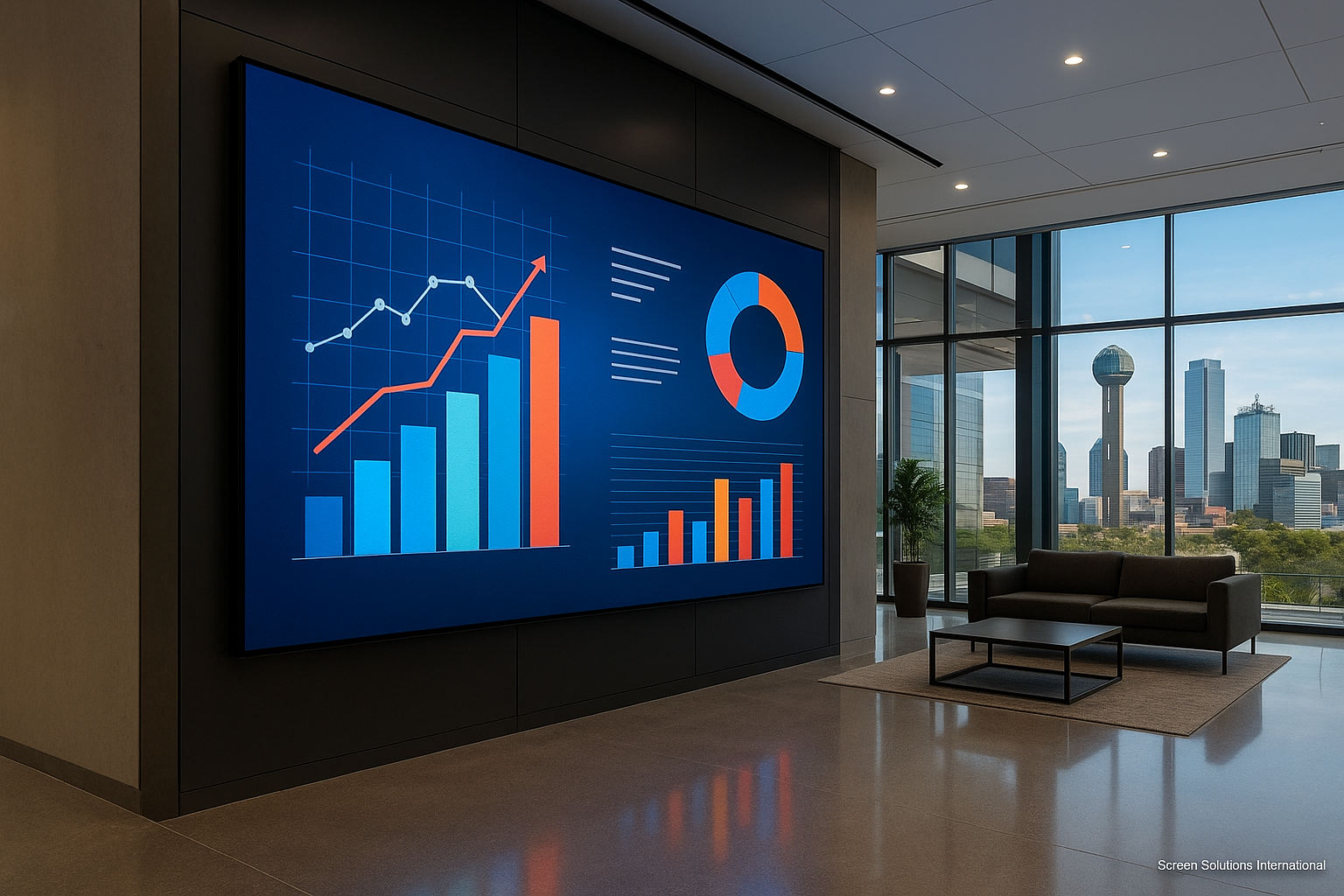
Ask what an LED video wall costs and the honest answer is “it depends,” which is not much help when you need a budget for a Dallas lobby, church, venue or storefront. What you can do is understand exactly what drives the number, so you can compare quotes properly and decide where to spend and where to save.
This guide breaks an LED wall budget into its parts, explains which choices move the total most, covers costs that are specific to North Texas projects, and gives a checklist for comparing quotes. For a project-specific estimate, call 888-631-5880.
The parts of an LED wall budget
An LED wall quote usually includes more than the screen. Expect these line items:
| Line item | What it covers | Share of budget |
|---|---|---|
| LED cabinets and modules | The display surface, sized by area and pixel pitch | Usually the largest single item |
| Processing and control | Video processor, sending cards, media player or controller | Small to moderate |
| Structure and mounting | Wall brackets, freestanding frame, rigging or outdoor steel and foundation | Small indoors, large outdoors |
| Electrical and data | Dedicated circuits, cabling, network drops | Small to moderate |
| Installation and commissioning | Labour, lifts, calibration, testing | Moderate |
| Content and software | Content management system, initial content creation | Varies widely |
| Spares and support | Spare modules, service plan, training | Small but important |
| Permits and engineering | Sign permits, structural drawings, inspections | Mostly for outdoor signs |
When two quotes differ a lot, the gap is usually in structure, installation or what is quietly left out, not just the panels.
The choices that move the price most
Pixel pitch
Pixel pitch is the distance between LED pixels. Finer pitch means more LEDs per square meter, so cost rises quickly as pitch drops. Halving the pitch roughly quadruples the number of pixels in the same area. The practical rule is to choose the coarsest pitch that still looks good at your closest regular viewing distance, using about 1 m of viewing distance per 1 mm of pitch as a guide. Paying for 1.2 mm in a space where nobody stands closer than 4 m is a common overspend.
Size
Cost scales roughly with area. A wall that is 20 percent larger costs close to 20 percent more in panels, plus a little more in structure and power. Designing the wall around standard cabinet sizes (often 500×500 mm or 500×1000 mm) avoids custom cuts that add cost.
Indoor, window-facing or outdoor
Indoor panels are rated around 600–1,500 nits. Window-facing displays need about 2,500–5,000 nits, and outdoor displays about 5,000–8,000+ nits plus IP65 or higher sealing on the front. Each step up adds cost per square meter, and outdoor projects add steel, foundations and permits.
Display type
A standard direct view LED video wall is the baseline. COB all-in-one displays bundle everything in fixed sizes and can simplify installation in meeting rooms and lobbies. Transparent, flexible and creative shapes cost more per square meter because of their construction and the custom work involved.
Camera and performance needs
Walls that appear on camera, such as in churches, studios and event venues, benefit from refresh rates of 3,840 Hz or higher and better processing. That adds cost but prevents flicker and banding on video.
How the same budget question plays out in two projects
Take two projects of similar screen area. The first is an indoor lobby wall seen from 3–4 m. It can use a pitch around 2.5 mm, mounts to an existing wall, needs modest brightness and goes in over a few days. Most of the budget goes to the panels and processor.
The second is an outdoor sign at a retail center entrance, seen from the road. It can use a much coarser pitch, around 8–10 mm, which lowers the panel cost per square meter. But it needs high brightness, weather sealing, a steel structure, a foundation, engineered drawings and a city permit. The total can easily end up higher than the lobby wall, even though the panels themselves cost less. Comparing projects by screen size alone is misleading for this reason.
Costs specific to Dallas-area projects
- Heat management. Outdoor and west-facing installations in North Texas need cabinets rated for high operating temperatures and designs that let heat escape. Enclosures with forced ventilation or cooling add cost.
- Wind and storm engineering. Outdoor structures need engineering for local wind loads. Some owners also budget for hail protection or insurance.
- Permits. Each city in the metro has its own rules for electronic signs. Drawings, application fees and inspection time belong in the budget for outdoor signs.
- Access and lifts. High atrium walls and building façades need lifts or scaffolding, which affects installation cost.
- Venue rules. Convention centers and some hotels require in-house labour or approved contractors for rigging and power, which affects event and rental budgets.
Purchase versus rental
Buying makes sense when the wall will be used most days, such as in a lobby, church, store or control room. Rental suits one-off events and occasional use, and it includes delivery, setup, operation and removal. Many organizations rent first for an event, then buy once they know the size and pitch they really need. See LED wall rental for event options.
Total cost of ownership
The purchase price is only part of the cost over the life of the wall. Factor in:
- Power. LED walls draw more power on bright content and at high brightness. Running indoor walls at the brightness the space actually needs saves energy.
- Maintenance. Budget for occasional module or power supply replacements and periodic cleaning and inspection.
- Content. Fresh content keeps the wall useful. Plan a yearly content budget, even if it is small.
- Lifespan. LED walls typically run for many years. Plan for a processor or media player upgrade during that time.
Our guide to LED video wall cost factors goes deeper into each of these.
Ways to keep the budget under control
- Choose the coarsest pitch that works for your real viewing distance.
- Design the wall around standard cabinet sizes.
- Avoid paying for brightness you will never use indoors.
- Use an existing solid wall instead of a freestanding frame where possible.
- Phase the project: install the main wall now and add secondary screens later.
- Reuse content templates across screens.
Checklist for comparing quotes
- Is the pixel pitch, size and resolution the same across quotes?
- Is brightness listed, and is it suitable for the location?
- Are processing, media players and software included?
- Are structure, electrical work and permits included or excluded?
- Is installation, calibration and training included?
- How many spare modules are supplied?
- What ongoing support and response times are offered?
For more planning help, see our LED display guides or contact us with your space, viewing distance and goals for a tailored quote.
LED displays in Dallas
For local options and a quote, see direct view LED video walls in Dallas, trade show LED displays in Dallas and transparent LED displays in Dallas.
FAQ
What has the biggest effect on LED video wall cost?
Pixel pitch and size, followed by whether the display is indoor or outdoor. Finer pitch and higher brightness both raise the cost per square meter.
Why do LED wall quotes vary so much?
Quotes often include different things. Compare pitch, size and brightness, then check whether structure, installation, processing, permits and spares are included.
Are outdoor LED walls in Dallas more expensive?
Yes, per square meter. They need higher brightness, weather sealing, heat management, engineered structures and often city permits.
Is it cheaper to rent an LED wall for an event?
For one-off or occasional events, rental is usually more economical. For daily use, purchase typically costs less over time.
What ongoing costs should I budget for?
Power, occasional parts, cleaning, content updates and eventual processor or player upgrades.